 Semblance
Looksmaxxing
What Is Canthal Tilt?

In short
Canthal tilt is the angle of your eye measured from the inner corner (near the nose) to the outer corner. A positive canthal tilt means the outer corner sits higher than the inner corner — the look most consistently rated attractive. A neutral tilt is level, and a negative tilt means the outer corner sits lower, which can read as tired or downturned. Most people fall between neutral and slightly positive, and a difference of a few degrees is invisible in everyday life.
What is canthal tilt?
The canthus is the corner of the eye where the upper and lower eyelids meet. Every eye has two: the inner canthus near the nose and the outer canthus at the temple side. Canthal tilt is the angle of the line drawn between them. When the outer canthus is higher than the inner one, the tilt is positive; when it is lower, the tilt is negative.
The angle is set by the bone structure of the eye socket and the position of the tendon that anchors the outer corner. It is largely genetic, and it can drift slightly more negative with age as the tissue around the eye loosens. It became a mainstream search term through a viral TikTok filter that claimed to measure it — which is also where most of the confusion about it comes from.
What are the types of canthal tilt?
Three categories, defined only by where the outer corner sits relative to the inner corner.
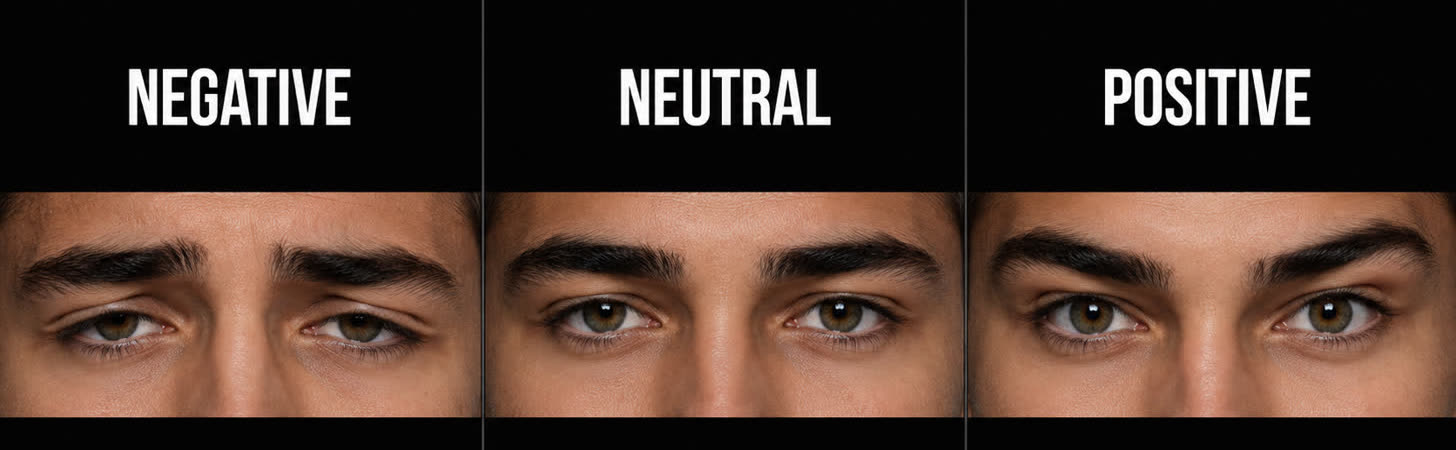
The outer corner sits higher than the inner corner, usually by about 5 to 10 degrees. It gives an alert, lifted, almond-shaped look and is the tilt most consistently rated attractive across cultures. This is what the looksmaxxing community calls part of "hunter eyes."
The inner and outer corners are roughly level, with no noticeable angle. This is where a large share of people sit. It reads as balanced and unremarkable — neither a strength nor a weakness in most faces.
The outer corner sits lower than the inner corner, giving a softer, sometimes tired or downturned look. It is the tilt people worry about most, but a mild negative tilt is common and often unnoticeable unless it is pronounced. Puffiness and poor sleep can make it look worse than it is.
What canthal tilt is most attractive?
A positive canthal tilt, in the range of about 5 to 10 degrees upward, is the most consistently preferred. Studies of facial attractiveness associate an upward outer eye corner with youth and alertness, which is why it reads well. A neutral tilt is a close second and is entirely normal.
The honest caveat: a few degrees of tilt is not something people consciously register in conversation. Canthal tilt is one input into overall eye-area harmony, alongside eyelid exposure, brow position, and the under-eye area — no single one of them decides how attractive a face is.
What is the average canthal tilt?
Most people have a slightly positive canthal tilt, typically a few degrees upward, with a large group sitting close to neutral. A genuinely strong negative tilt is less common than the looksmaxxing conversation suggests. This matters because it reframes the anxiety: measuring "slightly negative" or "neutral" puts you where most of the population already is, not in a rare failing category.
How do I tell my canthal tilt?
Face a mirror head-on, at eye level, with a relaxed expression. Find the inner corner and outer corner of one eye and picture a straight line between them. If the outer corner is higher, your tilt is positive; if lower, negative; if level, neutral. For a precise reading, take a straight-on photo at eye level and draw the line on it.
The catch almost everyone misses: your phone selfie fakes a negative tilt. A front camera held below eye level, combined with the wide-angle lens on a phone, distorts the face — it stretches the lower half and drops the apparent position of the outer eye corners. The same face that looks neutral at eye level can look negative in a selfie shot from chin height. The viral TikTok canthal-tilt filter inherits the exact same distortion.
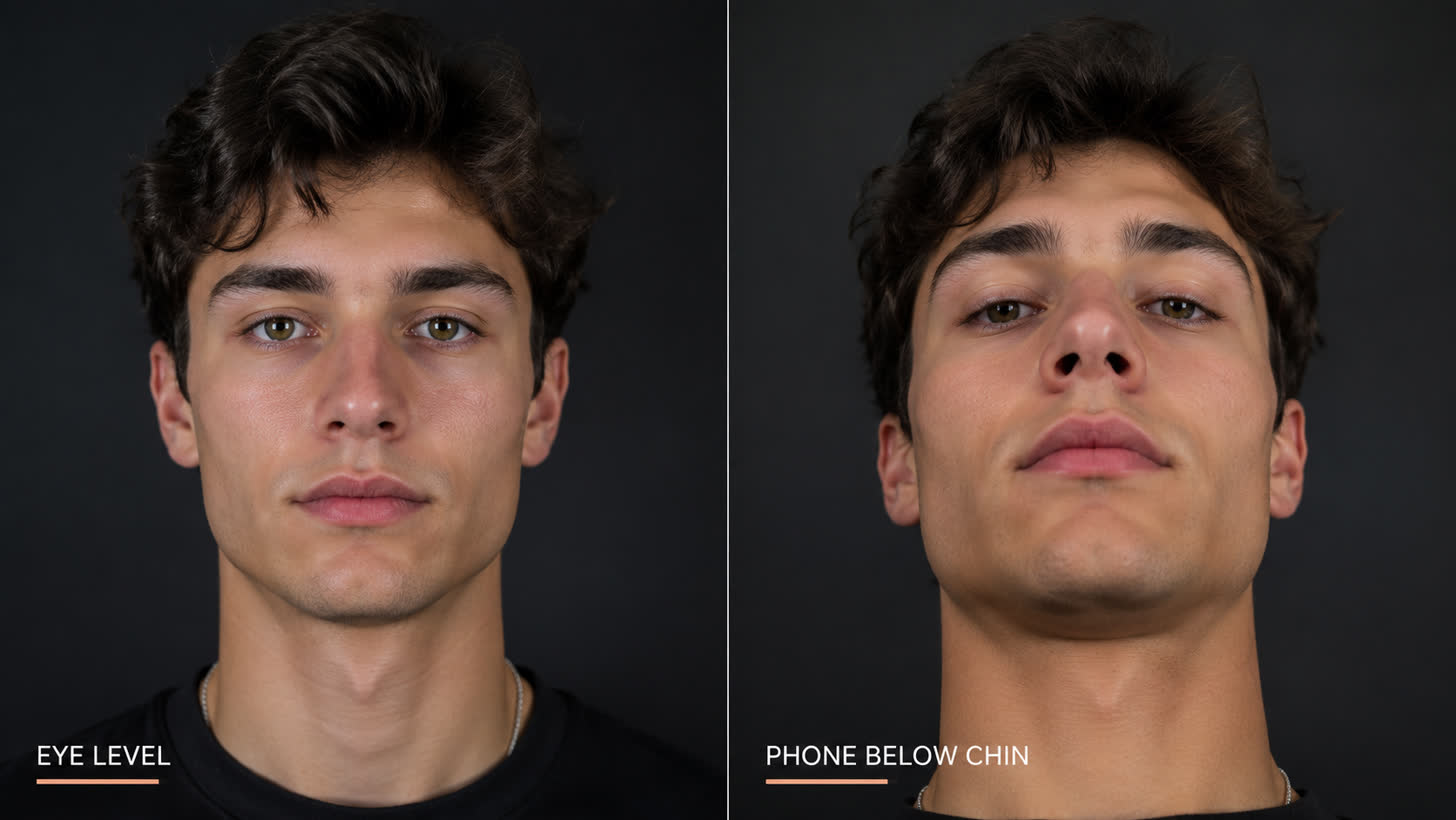
Same face, same day. Camera height and lens distortion — not your anatomy — change the apparent tilt.
Does canthal tilt actually matter?
It matters as one feature among several, not as a verdict. A positive tilt is a genuine asset and a strong negative tilt is a real feature to be aware of — but the difference between neutral and slightly positive is not something other people consciously notice. The looksmaxxing framing of "negative tilt means it's over" is not supported by how faces are actually perceived.
Eye-area attractiveness is a combination: tilt, how much upper eyelid shows, brow position and shape, and whether the under-eye area looks rested. A face can have a neutral or mildly negative tilt and still read as striking because the rest of the eye area is working.
Does Timothée Chalamet have a negative canthal tilt?
Timothée Chalamet is one of the most cited examples in this conversation, and he is generally described as having a neutral to slightly negative canthal tilt — yet he is widely considered one of the most attractive men in film. He comes up constantly in looksmaxxing threads precisely because he breaks the rule: a tilt that is not textbook-positive, paired with a face that reads as extremely attractive.
He is the clearest proof that canthal tilt is not a make-or-break trait. Other strong features — bone structure, symmetry, and the rest of the eye area — carry the face regardless of a perfectly lifted outer corner.
Can I fix my canthal tilt?
The angle itself is structural, so genuinely changing it means a procedure. Lateral canthoplasty and canthopexy are the surgeries that reposition the outer corner of the eye to lift the tilt; a lateral brow lift can also change how the outer eye area reads. These are real cosmetic procedures with real recovery and risk, and they are the only way to move the underlying angle.
Is it possible to change canthal tilt naturally? Not the bony angle — no exercise, massage, or "mewing" changes where the tendon anchors the outer corner. What you can change is how the tilt reads: reducing under-eye puffiness and getting proper sleep de-emphasises a mild negative tilt, and grooming the brow changes the framing of the whole eye area. Those improve the appearance without touching the structure.
See it on your own eyes before deciding.
Before concluding anything from a selfie or a filter, see your actual eye area — measured properly, at eye level — and preview what an eye-area change would look like on your own face. Semblance generates a realistic, identity-preserving preview of changes like an eyelid lift, brow lift, or reduced under-eye puffiness from a single photo, so you can see the real delta instead of a distorted guess. Previews are illustrative, for exploration — not a prediction of a surgical outcome.
See it on your own photo →Canthal Tilt FAQ
Common questions.
What canthal tilt is most attractive?+
A positive canthal tilt of about 5 to 10 degrees upward is the most consistently preferred, because an upward outer eye corner reads as youthful and alert. A neutral tilt is a close, entirely normal second. In practice a few degrees of difference is not something people consciously notice.
How do I tell my canthal tilt?+
Face a mirror head-on at eye level and picture a line from the inner corner to the outer corner of one eye. Higher outer corner means positive, lower means negative, level means neutral. Use a straight-on photo taken at eye level for accuracy — not a selfie held below your chin, which distorts the angle.
Does the TikTok canthal tilt filter actually work?+
Not reliably. The filter measures whatever the camera shows, and a phone held below eye level with a wide-angle lens distorts the face and drops the apparent outer eye corners. This makes many people measure a false negative tilt. Only a straight-on photo taken at eye level gives an accurate reading.
Does Timothée Chalamet have a negative canthal tilt?+
He is generally described as having a neutral to slightly negative canthal tilt, and he is still widely considered highly attractive. He is a common example that canthal tilt is one feature among many, not a make-or-break trait.
Can I fix my canthal tilt?+
The angle itself is structural, so changing it means a procedure — lateral canthoplasty or canthopexy repositions the outer corner of the eye. Non-surgically you cannot change the bony angle, but reducing under-eye puffiness, sleeping well, and grooming the brow all change how the tilt reads.
Is a negative canthal tilt bad?+
A mild negative tilt is common and usually unnoticeable in everyday life. Only a pronounced negative tilt is a distinct feature, and even then it is one input into eye-area harmony rather than a verdict on attractiveness. The "it's over" framing is not how faces are actually perceived.
Sources
- Wikipedia — Canthus
- American Society of Plastic Surgeons — Eyelid Surgery
- Wikipedia — Looksmaxxing
Related guides